Kate Berry Brown: Holding Form
Sep 17 - Oct 31 2026
- 5 days left
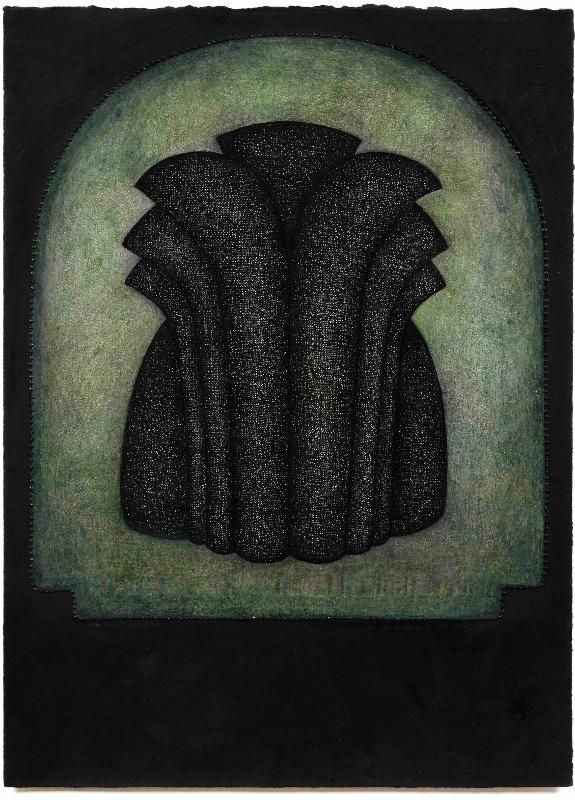
Kate Berry Brown, born in 1978 and raised in Evanston, Illinois, studied fashion design at Washington University before finding her way to drawing, a medium she embraced for both its immediacy and meditative repetition. Her earlier abstract ink drawings on cut paper eventually prompted a desire to give those forms physical dimension, leading her into several years of carved wood and paper sculpture. Now, Brown returns to paper with that sculptural experience embedded in her hand. Bringing a heightened sense of volume, weight, and edge back to two dimensions, she builds each form through dense accumulations of colored pencil and ink—thousands of minute marks that coalesce into singular shapes.
Brown thinks of these works as portraits, because each asserts itself as an individual presence: squat or elongated, solitary or paired, upright, folded. Their differences begin to feel almost temperamental. At the same time, their swelling contours suggest vessels—forms organized around an interior. Brown imagines that unseen space as a repository for the memories, stray thoughts, wasted hours, private griefs, small joys, and inherited ideas that accumulate inside a life.
Hovering between body, object, architecture, and abstraction, the drawings resist fixed identities and reward sustained looking.